
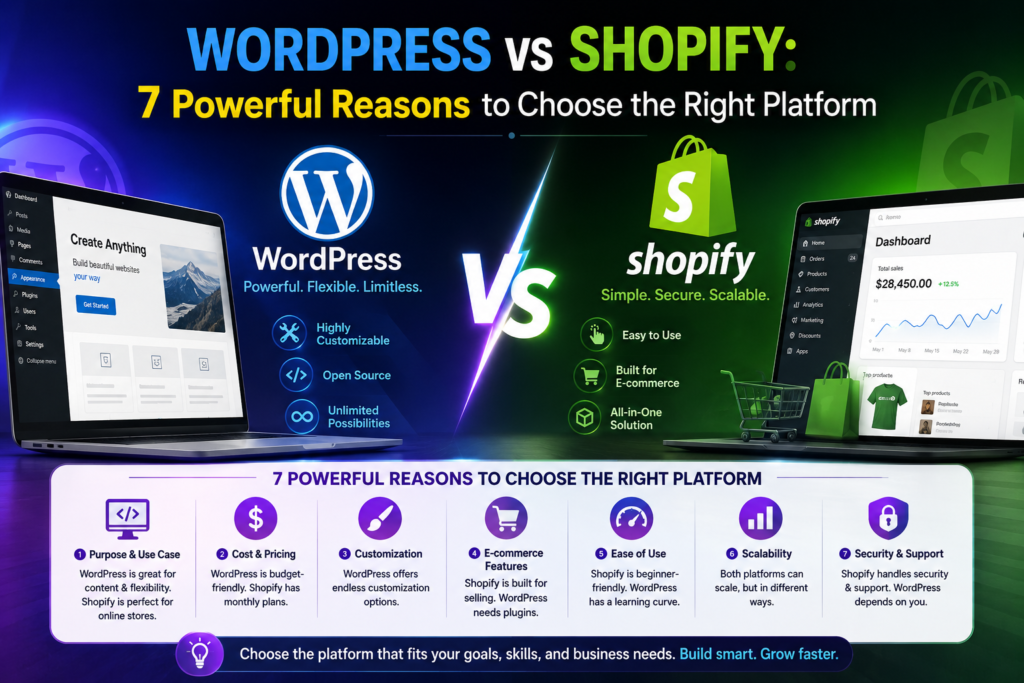
WordPress vs Shopify: 7 Powerful Reasons to Choose the Right Platform for Your Business in 2026
Choosing the right website platform can have a major impact on your business’s online growth. Whether you are launching a new online store, building a service-based website, or expanding an existing business, the platform you choose affects your design, SEO, performance, scalability, maintenance, and overall customer experience.
Two of the most popular options are WordPress and Shopify. Both platforms are powerful, but they are designed with different business needs in mind.
So, WordPress vs Shopify: which is better for your business in 2026?
The answer depends on what you want to achieve. In this guide, we will compare both platforms across 7 powerful factors, including ease of use, customization, SEO, e-commerce capabilities, cost, security, and scalability.
1. WordPress vs Shopify: Understanding the Difference
WordPress is a flexible content management system that can be used for blogs, business websites, portfolios, membership websites, and online stores. With WooCommerce, WordPress can become a complete e-commerce platform.
Shopify, on the other hand, is an e-commerce-focused platform designed primarily for businesses that want to sell products online. It provides hosting, payment integrations, product management, order processing, and store management within one ecosystem.
In simple terms:
- WordPress offers extensive flexibility and customization.
- Shopify offers a streamlined and powerful e-commerce experience.
If content, SEO, blogging, and complete website control are important to you, WordPress can be an excellent choice. If your main objective is selling products online with minimal technical management, Shopify can be highly effective.
2. 7 Powerful Customization Advantages of WordPress
One of WordPress’s biggest strengths is customization.
You can choose from thousands of themes and plugins to modify your website’s appearance and functionality. Developers can also customize the website using HTML, CSS, JavaScript, PHP, and other technologies.
This makes WordPress suitable for businesses that need a unique website rather than a standard online store.
For example, a business could create:
- Professional corporate websites
- Blogs and content platforms
- Service-based websites
- Portfolio websites
- Membership websites
- Online stores
- Booking websites
- Learning platforms
Shopify also offers themes, apps, and customization options. However, its structure is more focused on e-commerce.
Winner for customization: WordPress
3. SEO: WordPress vs Shopify for Google Rankings
SEO is essential if you want customers to discover your business through search engines.
WordPress provides extensive SEO flexibility. Plugins such as SEO tools can help businesses manage titles, meta descriptions, XML sitemaps, schema, redirects, content optimization, and other important SEO elements.
WordPress is particularly powerful for businesses that rely heavily on content marketing and blogging.
Shopify also supports important SEO features, including customizable titles, meta descriptions, URLs, redirects, and other optimization capabilities. However, some technical aspects have more platform-level limitations compared with WordPress.
If your long-term strategy involves publishing articles, creating landing pages, targeting local keywords, and building topical authority, WordPress can provide greater control.
Winner for SEO flexibility: WordPress
4. E-Commerce: 5 Reasons Shopify Stands Out
This is where Shopify becomes extremely attractive.
Shopify was built specifically for e-commerce. It provides businesses with tools to manage products, inventory, orders, payments, shipping, discounts, and customer information.
You do not need to build an e-commerce system from scratch.
WordPress can also become a powerful online store through WooCommerce. It offers extensive flexibility and allows businesses to customize their store extensively.
However, that flexibility can also mean more setup and maintenance.
Shopify is often a better choice if your priority is:
- Launching an online store quickly
- Managing products easily
- Simplifying store administration
- Scaling an e-commerce operation
- Reducing technical maintenance
Winner for e-commerce simplicity: Shopify
5. Cost: Which Platform Gives Better Value?
Cost is another important factor when comparing WordPress and Shopify.
With WordPress, the software itself can be used without a platform subscription, but you generally need to consider expenses such as hosting, domain registration, premium themes, plugins, security, development, and maintenance.
Shopify uses a subscription-based model. Depending on your plan and requirements, you may also have additional expenses for apps, payment processing, premium themes, and other services.
Therefore, comparing only the monthly subscription price does not give you the complete picture.
Instead, consider your total cost of ownership.
A small business that needs a simple website may find WordPress economical. An e-commerce business may find Shopify worthwhile because many store-management functions are already integrated.
6. Security and Maintenance
Security should never be ignored when building a business website.
With Shopify, much of the technical infrastructure is managed by the platform. This reduces the amount of server-level maintenance required from the store owner.
WordPress gives you greater control, but that control comes with responsibility. You need to keep your WordPress core, themes, and plugins updated. You should also use reliable hosting, backups, security tools, strong passwords, and appropriate access controls.
This does not mean WordPress is insecure. A properly configured and maintained WordPress website can be highly secure.
The difference is primarily about responsibility.
Winner for easier maintenance: Shopify
Winner for control: WordPress
7. Scalability: Which Platform Can Grow With Your Business?
A website should not only meet your current requirements. It should also support your future growth.
WordPress can scale from a small business website into a complex digital platform. With appropriate hosting, caching, database optimization, CDN configuration, and development practices, WordPress can handle significant traffic and functionality.
Shopify can also scale effectively for growing online stores. Its infrastructure is designed around e-commerce, making it attractive to businesses that expect increasing product sales and customer activity.
The right choice depends on the direction of your growth.
If you expect to expand into content marketing, lead generation, services, communities, and custom website functionality, WordPress offers impressive flexibility.
If your business is primarily focused on e-commerce and product sales, Shopify can provide a powerful foundation.
WordPress vs Shopify: Quick Comparison
| Feature | WordPress | Shopify |
|---|---|---|
| Customization | Excellent | Very Good |
| SEO flexibility | Excellent | Very Good |
| Blogging | Excellent | Good |
| E-commerce | Excellent with WooCommerce | Excellent |
| Ease of setup | Moderate | Excellent |
| Maintenance | Requires management | Easier |
| Design flexibility | Excellent | Very Good |
| Technical control | Excellent | Moderate |
| E-commerce management | Very Good | Excellent |
| Scalability | Excellent | Excellent |
8. Which Platform Is Better for Your Business?
There is no universal winner.
Choose WordPress if you want:
- Maximum website customization
- Strong content marketing capabilities
- Advanced SEO flexibility
- A service-based business website
- Complete control over your website
- Blogging and publishing capabilities
- Custom functionality
- A website that can evolve beyond traditional e-commerce
Choose Shopify if you want:
- A dedicated e-commerce platform
- Faster store setup
- Simple product management
- Easier technical maintenance
- Integrated e-commerce tools
- A platform designed primarily for online selling
For example, a digital marketing agency, consultant, lawyer, salon, healthcare provider, or local business may benefit greatly from WordPress.
An apparel store, electronics retailer, fashion brand, or product-based business may prefer Shopify.
Final Verdict: WordPress vs Shopify in 2026
So, WordPress vs Shopify: which is better for your business?
The answer comes down to your goals.
WordPress is the powerful choice for businesses that want flexibility, customization, content marketing, and SEO control. Shopify is an excellent choice for businesses that want a streamlined, scalable, and easy-to-manage e-commerce platform.
Instead of choosing a platform simply because it is popular, think about your business model, target audience, budget, technical requirements, marketing strategy, and future plans.
The best website platform is not necessarily the one with the most features. It is the one that supports your business goals and helps you deliver a better experience to your customers.
If you are still unsure, start by defining what your website needs to accomplish. Once your goals are clear, choosing between WordPress and Shopify becomes much easier.
Primary SEO Keyword
7 Powerful WordPress vs Shopify Comparison: Which Is Better for Your Business in 2026?
Suggested Secondary Keywords
- WordPress vs Shopify
- WordPress vs Shopify for business
- WordPress vs Shopify for e-commerce
- Shopify vs WordPress SEO
- best website platform for business
- WordPress or Shopify which is better
- WordPress vs Shopify 2026
- best e-commerce platform for small business
Frequently Asked Questions About WordPress vs Shopify
1. Is WordPress better than Shopify for SEO?
WordPress can offer greater SEO flexibility, especially for businesses that rely heavily on blogging, content marketing, and detailed on-page optimization. Shopify also provides essential SEO features and can perform well when properly optimized.
The better choice depends on how important content and technical SEO control are to your marketing strategy.
2. Is Shopify better than WordPress for an online store?
Shopify can be a more convenient choice for businesses that primarily want to sell products online. Its e-commerce-focused environment simplifies product management, order processing, and store administration.
However, WordPress with WooCommerce can be an excellent alternative for businesses that require extensive customization.
3. Which platform is easier for beginners?
Shopify is generally easier for beginners because much of the technical infrastructure is managed as part of the platform.
WordPress can require more initial configuration, especially when choosing hosting, themes, plugins, backups, and security solutions. However, once properly configured, it can be relatively easy for non-technical users to manage everyday content.
4. Can WordPress and Shopify handle large businesses?
Yes. Both platforms can support growing businesses, although they approach scalability differently.
WordPress can be expanded through hosting improvements, optimization, custom development, and additional functionality. Shopify provides an infrastructure designed around e-commerce and can support businesses as their online operations grow.
The right choice depends on the type of growth your business expects.
5. Which is better for a small business?
There is no universal answer.
A small business that needs a website for services, local SEO, blogging, lead generation, or branding may find WordPress particularly useful.
A small business selling physical products online may prefer Shopify because of its dedicated e-commerce features and simpler store management.
6. Can WordPress be used for e-commerce?
Yes. WordPress can be used to build an online store with WooCommerce. It provides businesses with the ability to manage products, payments, inventory, orders, shipping, and other e-commerce functions.
Its biggest advantage is that businesses can customize the store around their specific requirements.
7. Can Shopify be used for blogging?
Yes. Shopify includes blogging functionality, allowing businesses to publish articles and educational content.
However, businesses with a content-heavy marketing strategy may prefer WordPress because content publishing and website customization are among its core strengths.
WordPress vs Shopify for Local Businesses
Local businesses should consider more than just e-commerce when selecting a website platform.
A local business may need service pages, location-based landing pages, blogs, contact forms, customer reviews, Google Business Profile support, lead-generation forms, and strong local SEO.
WordPress can be useful for this type of website because businesses can create dedicated pages around different services and locations.
For example, a digital marketing agency could create separate pages for:
- SEO services
- Website development
- Social media marketing
- Google Ads
- Local SEO
- Content marketing
This structure can support a broader organic search strategy.
Shopify can still be useful for local businesses that sell products online. A boutique, clothing store, cosmetics brand, or specialty retailer can combine a physical location with an online Shopify store.
Therefore, the decision should be based on whether your website is primarily a business information and lead-generation platform or an e-commerce sales platform.
WordPress vs Shopify for Branding
Your website plays an important role in how customers perceive your business.
WordPress can provide extensive freedom when creating a completely customized brand experience. Businesses can control page layouts, animations, typography, landing pages, content structures, and other design elements.
Shopify also offers professional themes and customization options. Its advantage is that businesses can create a polished online store without having to build every e-commerce component themselves.
For businesses where branding is the primary focus, WordPress can offer more creative freedom.
For product brands that want to combine branding with a straightforward shopping experience, Shopify can be highly effective.
Performance: Does WordPress or Shopify Load Faster?
Website performance is important for both users and search engines.
Neither platform is automatically fast simply because of the platform itself. Performance depends on factors such as image optimization, page structure, scripts, apps, plugins, hosting, caching, and website configuration.
A poorly optimized WordPress website can become slow because of excessive plugins, large images, inefficient themes, or weak hosting.
Likewise, a Shopify store can experience performance issues when it contains excessive third-party apps, heavy themes, or unnecessary scripts.
The goal should therefore be to build a lightweight website regardless of the platform.
Businesses should focus on:
- Compressing images
- Using optimized themes
- Reducing unnecessary scripts
- Limiting unnecessary plugins or apps
- Improving mobile performance
- Monitoring Core Web Vitals
- Using reliable infrastructure
A well-optimized website can provide a much better user experience and potentially improve conversions.
Migration: Can You Move From WordPress to Shopify?
Yes, businesses can migrate from one platform to another, although migration requires careful planning.
If a company moves from WordPress to Shopify, it may need to transfer products, customer information, content, images, URLs, and other data depending on its existing website.
SEO should receive special attention during migration.
Old URLs should be mapped correctly, appropriate redirects should be implemented, and important pages should not simply disappear. Businesses should also monitor rankings and traffic after migration.
The same principle applies when moving from Shopify to WordPress.
A platform migration should not be treated as simply moving files from one system to another. It is also an SEO, user-experience, and business continuity project.
What Should You Consider Before Choosing?
Before selecting WordPress or Shopify, create a simple list of your business requirements.
Consider these questions:
1. What is the main purpose of the website?
Is it primarily for services, branding, content, lead generation, or selling products?
2. How much customization do you need?
If you need unique functionality and extensive control, WordPress may be more suitable.
3. How important is e-commerce?
If online selling is the central function, Shopify may provide a more streamlinedexperience.
4. Who will manage the website?
Consider whether you have a developer, marketing team, freelancer, or internal staff available for maintenance.
5. What is your long-term marketing strategy?
Think about SEO, blogging, paid advertising, social media, email marketing, and content creation.
6. What is your budget?
Don’t only calculate the initial setup cost. Consider hosting, apps, plugins, maintenance, development, security, and marketing expenses.
7. What will the business look like in three years?
Your platform should be capable of supporting your future goals rather than only solving today’s problem.
The Smartest Way to Make the Decision
Instead of asking, “Which platform is the best?”, ask:
“Which platform is best for my business model?”
That small change in thinking can make the decision much easier.
For a content-driven business, WordPress may provide the flexibility needed to build a strong online presence.
For an e-commerce-first business, Shopify may simplify the process of creating and managing an online store.
For businesses that need a mixture of content, SEO, lead generation, branding, and e-commerce, WordPress can provide extensive customization.
There is also no need to choose a platform simply because competitors are using it. Your business has different customers, resources, goals, and operational requirements.
Conclusion
The WordPress vs Shopify debate does not have a universal winner.
WordPress is particularly strong in customization, content management, SEO flexibility, and control. Shopify is particularly strong in e-commerce simplicity, store management, and reducing technical responsibilities.
The smartest decision is to evaluate your business goals first and then select the platform that supports them.
If your priority is flexibility, content, SEO, branding, and customization, WordPress may be the right direction.
If your priority is selling products, simplifying store management, and reducing technical complexity, Shopify may be the better fit.
Ultimately, a successful website is not determined only by the platform behind it. Design, SEO, content, speed, security, user experience, marketing, and consistent optimization all play important roles.
Choose the platform that gives your business the right foundation—and then focus on building a website that genuinely helps your customers.